No products in the cart.

 Add Kesari Weekly as a preferred source on Google


When the American president pointed his finger at India and called our customs duty obnoxious the gesture carried the same tone that a headmaster uses on a late schoolboy. The threat was clear. Fall in line or face more pain. New Delhi stayed silent in public, but the silence was not surrender. It was the old Indian habit of waiting for the right moment to answer. That moment is now arriving, and it is arriving from the East and the North.
Long before there was a Westphalian treaty or a United Nations there was already a Silk Road that carried bolts of Banarasi silk to Kashgar and caravans of Kashmiri saffron to Samarkand. The travellers spoke Sanskrit Persian Tibetan and a dozen dialects of Prakrit. They carried ideas of zero and the concept of dharma and the art of bronze casting. None of them asked for a rule book written in London or New York. They relied on mutual benefit and on the simple understanding that if the goods are good the trade will continue. That memory is still alive in our bones.
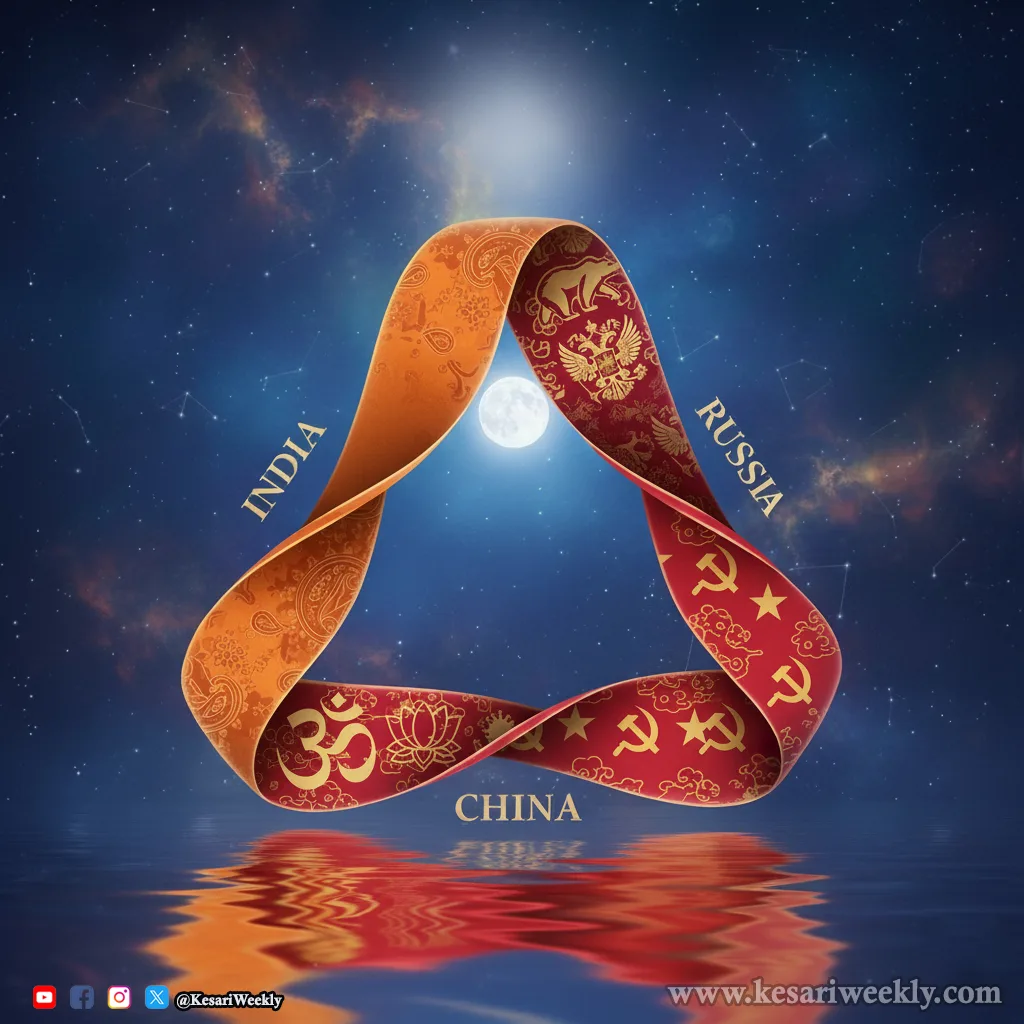
Thomas Sowell teaches us that every policy choice is made within constraints, and every constraint shapes the incentive. The constraint that India faces today is the tightening grip of American financial and technological power. The incentive is to loosen that grip by finding partners who have matching needs and matching strengths. China needs our young minds. Russia needs our market. We need their capital and them know how. The triangle therefore is not a romantic dream. It is a hard headed response to hard constraints.

Let us look at the balance sheet without any jargon. China today can pour more concrete in a month than Europe in a year. It can lay a thousand kilometres of high speed rail while other nations are still choosing the colour of the seats. India can write software and train engineers in numbers that no European university system can match. Russia still builds reactors that work in the Arctic cold and missiles that can travel from the Urals to the Arabian Sea in minutes. Put these three endowments together and the sum is larger than any one side can imagine.
The West speaks of a rules based order. Yet the rules are written after the game has started and the referee wears the jersey of the home team. When Microsoft threatened to cut updates on Indian computers after the Nayara sanctions every Indian office felt the chill. The lesson was simple. If you do not own the switch you do not own the light. Therefore we must build our own switches. The Chinese have already built TikTok and WeChat and Baidu. They did it because their market was large enough and their state was determined enough. India now has the market size and soon will have the determination. A joint venture between a Chinese video platform and an Indian start up can give Africa its first social network that is not mined for Atlantic data. That is not charity. That is new business.
Defence tells the same story. Russia still gives India the lease of a nuclear submarine and the transfer of rocket engines. America sells arms but never the latest version and never without an end user agreement that turns each screw into a legal case. The path ahead is not to abandon American weapons overnight but to deepen Russian design links and Chinese component supply so that the next fighter jet carries the stamp of three nations. This will cut cost and cut delivery time and cut the leverage of any single supplier.
Education must follow the same logic. IIT Delhi and Tsinghua University have already begun joint research on artificial limbs and on low cost solar panels. The results are published in journals that the West reads but cannot block. More such labs must come up in Mumbai and Vladivostok and Chengdu. When an African student can choose between a Harvard that costs a fortune and an Indo Chinese programme that costs half and teaches practical skills the balance of soft power will shift.
Africa is the test case. Western headlines still treat the continent as a place of famine and coups. The reality on the ground is young population and untapped ore and soil that can feed the world. China already builds ports in Kenya and railways in Ethiopia. India runs power lines in Rwanda and digital payments in Ghana. Russia trains security forces in the Central African Republic. If the three nations pool finance and planning then a new Addis Ababa to Lagos railway can be built in seven years instead of twenty. The profits will stay in Africa the workers will be African and the technology will be jointly owned. That is the opposite of neo colonialism.
Some will ask whether such a triangle will create a new empire. Sowell reminds us that what matters is not the label but the incentives inside the structure. If every rail ticket sold in Africa gives a small royalty to an African government then the incentive is to keep the rail running not to wreck it. If every Indian engineer sent to Chengdu comes back with a fatter salary and a Chinese patent shared fifty fifty then the incentive is to deepen the tie not to break it. Power that is built on mutual profit is self limiting because it punishes the aggressor as quickly as the victim.
The West fears this possibility precisely because it cannot control it. Therefore it will use the old language of debt traps and authoritarian plots. The answer is not to shout back but to deliver results. When a Kenyan mother can board a Chinese built Indian managed electric train that runs on Russian designed nuclear power she will not care which foreign ministry issued the press release. She will care that her child reached the hospital before the fever turned fatal. That is the new rule book and it is written in daily life not in diplomatic communiques.
Numbers help to keep the argument honest. At present the combined GDP of India China and Russia is roughly twenty eight trillion dollars measured in real purchasing power. If India grows at eight percent China at five and Russia at three then by the year 2040 the total will touch fifty trillion. That is still behind the United States plus Europe but the gap will be narrowing. More important the growth will be happening in the same contiguous landmass from Vladivostok to Kochi. Trade within this landmass will not need aircraft carriers to keep sea lanes open. Overland rail and pipeline will do the job. Cost will fall and resilience will rise.
The BRICS bank already lends in local currency. A rupee yuan rouble settlement system is under quiet trial. Once these rails are in place the dollar will lose its veto power. That may sound technical but the effect will be felt in every small town. When an Indian importer can pay a Russian exporter in roubles converted at a transparent rate set in Mumbai and Shanghai then American sanctions will become a paper tiger. The farmer in Vidarbha will not know the details but he will notice that fertiliser prices no longer jump when Washington sneezes.
Civilisational depth gives this project patience. The Indian mind is trained in the long cycles of karma and the Chinese mind in the long view of history and the Russian mind in the long winters that teach endurance. None of these cultures believes that history ends in a single lifetime. Therefore the triangle does not need to hurry. It needs only to stay steady. Each decade that passes will add more roads more students more joint patents and more African partners. The West can slow the process but it cannot reverse it because the underlying incentives are moving in one direction.
This does not mean blind harmony. India and China still argue over a high altitude border. India and Russia still differ on Afghanistan. China and Russia still compete for influence in Central Asia. These quarrels are real and they will continue. Yet Sowell teaches that conflict is managed by raising the cost of escalation and lowering the prize of betrayal. When a Chinese smartphone factory in Noida employs ten thousand Indians and pays local taxes the cost of a border clash rises for Beijing. When a Russian oil company lists its shares on the Bombay Stock Exchange the cost of a military adventure rises for Moscow. These are not idealistic pledges. They are hard headed calculations.
We must also speak plainly about democracy and human rights. The West claims a monopoly on both. Yet its own record shows coups in Latin America and torture chambers in black sites. The triangle must offer a different example. India already holds elections with more voters than Europe and North America combined. China has lifted eight hundred million out of poverty faster than any society in history. Russia guarantees free education and health care to every citizen. None of these systems is perfect but none is a carbon copy of the other. That variety is a strength. It tells the world that prosperity can arrive through many doors.
The coming fifteen years will decide whether the twenty first century belongs to the Atlantic or to the Eurasian landmass. India does not need to choose between East and West. We can trade with both. Yet we must recognise that the West is trying to close doors while the East is opening them. When Trump threatened tariffs he thought he was teaching us a lesson. Instead he reminded us of an older lesson. No nation can grow rich by permission of another. Growth comes from skill and savings and the courage to walk through open doors.
Therefore the task before our planners is simple to state but hard to execute. Build more rail links to China and more pipelines to Russia. Invite more Chinese venture funds to Bengaluru and more Russian defence labs to Hyderabad. Send more IIT graduates to Wuhan and more IIM graduates to Kazan. Each step will be resisted by lobbies that profit from the old order. Each step must be defended in Parliament and in the media. Yet each step will also create a constituency inside India that earns from the new order. That is how change becomes irreversible.
Africa again shows the way. A new generation of African leaders studied in Soviet institutes and Chinese universities and Indian agricultural colleges. They speak Hindi and Mandarin and Russian. They do not see the world through London eyes. When they sign a contract they read the fine print and they ask for local shareholding. They are the children of Bandung and of BRICS. If India China and Russia treat them as equals they will repay with loyalty that no foreign aid can buy.
Let us end with a small picture that carries a large meaning. A village girl in Bihar opens her new phone and watches a short video made by a Nigerian comic and hosted on a Sino Indian platform. She laughs and shares it with her brother who is learning Mandarin in Patna University. Their father drives a tractor that runs on Russian diesel brought through an Iranian port and paid in rupees. None of them reads the Financial Times but all of them are part of the new world order. The order is not built on sermons about rules. It is built on the simple principle that every honest exchange leaves both sides better off. That principle is older than any empire and it will outlast every bully.
Jagath Jayaprakash
Academic administrator and researcher in education technology and AI, currently pursuing PhD at University of New Brunswick, Canada, after M.Ed. in Educational Leadership; formerly worked as an administrator at IIT Jammu. Author of several books on history, society, and policy.