No products in the cart.

 Add Kesari Weekly as a preferred source on Google
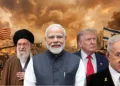


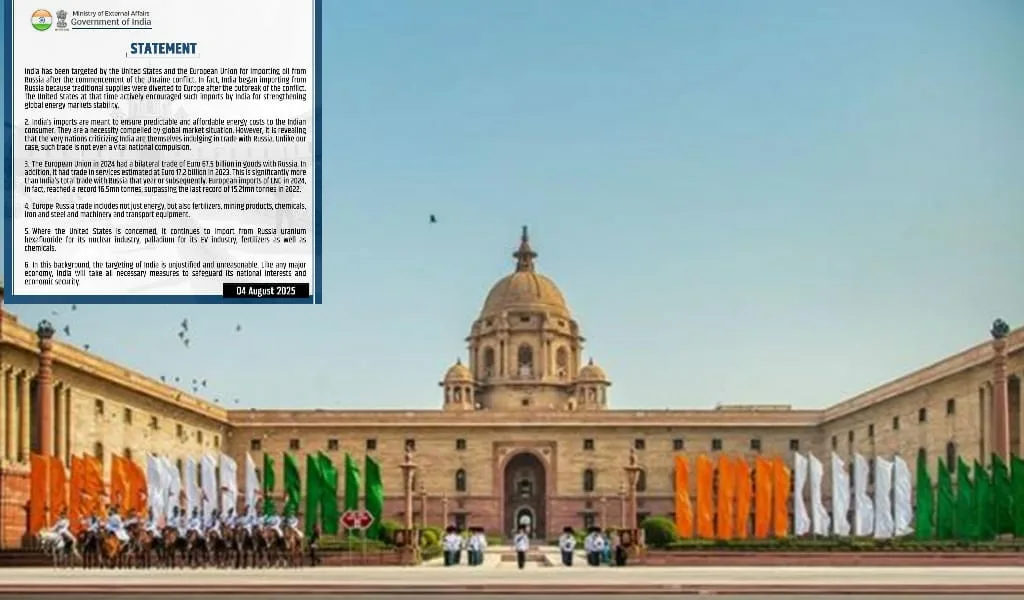
India has issued a sharp rebuttal to the United States and European Union over criticism of its oil imports from Russia. As tariff threats resurface, New Delhi has exposed the West’s glaring double standards and asserted its right to safeguard national interest.
In a powerful and clear-cut statement, India has hit back strongly at the United States and the European Union for their continued double standards over India’s oil imports from Russia. Responding to renewed threats of tariffs from the U.S. President Donald Trump, the Indian Ministry of External Affairs (MEA) laid bare the facts surrounding global trade with Russia and asserted that India will not compromise on its national interest.
The MEA pointed out that India began importing oil from Russia only after the Ukraine conflict broke out, at a time when traditional suppliers diverted their oil to Europe. Crucially, the U.S. itself had encouraged India to purchase oil from Russia to help stabilise global energy markets. Now, the very countries that prompted India to make these imports are attempting to target it for doing so. India described this behaviour as unjustified and unacceptable.
India made it clear that its energy imports are driven by national necessity and global market realities. The MEA stressed that India’s oil purchases ensure predictable and affordable energy prices for its citizens and are a fundamental economic requirement. Unlike the Western nations, India’s trade with Russia is strictly pragmatic and not discretionary.

Exposing the duplicity of its Western critics, India revealed that the European Union had a massive bilateral trade of €67.5 billion in goods with Russia in 2024. Additionally, EU-Russia services trade reached €17.2 billion in 2023, far exceeding India’s total trade with Russia in the same period or after. European imports of LNG from Russia reached a record 16.5 million tonnes in 2024, surpassing the previous high of 15.21 million tonnes in 2022.
Statement by Official Spokesperson⬇️
🔗 https://t.co/O2hJTOZBby pic.twitter.com/RTQ2beJC0W— Randhir Jaiswal (@MEAIndia) August 4, 2025
India also highlighted that Europe’s trade with Russia goes well beyond oil. It includes fertilizers, mining products, chemicals, iron and steel, machinery, and transport equipment. Similarly, the U.S. continues to import uranium hexafluoride for its nuclear industry, palladium for its electric vehicle industry, fertilizers, and chemicals from Russia.
These facts make it abundantly clear that the Western powers, while targeting India, are themselves engaged in extensive and even growing trade with Russia. India has categorically rejected this double standard and reaffirmed that it will take all necessary steps to safeguard its economic security.
Trump’s accusation that India profits from reselling Russian oil was also countered. India reiterated that its oil purchases are made in accordance with its national interest, not for profiteering. Trump’s statement, made on his social platform, Truth Social, ignores the reality that India imports nearly 85–90% of its crude oil needs and must navigate the global energy market responsibly to ensure domestic stability.
While Trump had earlier announced a 25% import duty on Indian goods on July 30, citing trade imbalances and Russian oil purchases, India refused to react hastily. Now, with Trump again threatening punitive tariffs without stating the specifics, India has firmly stated that it will not yield to such pressure tactics.
India also recalled that while trade negotiations with the U.S. were ongoing, India was unwilling to open its sensitive agricultural and dairy markets to American products. The MEA response signals that India will not accept unfair terms under the guise of partnership and will not allow itself to be targeted for decisions made in its sovereign interest.
Even as Trump announced that India would face harsher duties than countries like Pakistan, Bangladesh, Vietnam, and the Philippines, India maintained that it is open to resolving issues through dialogue, but not by compromising its autonomy or core interests.