No products in the cart.

 Add Kesari Weekly as a preferred source on Google



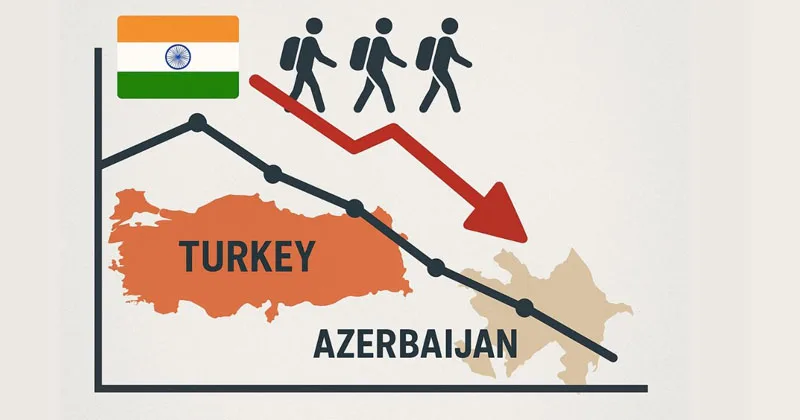
Azerbaijan and Turkey, once among the most preferred destinations for Indian tourists, are witnessing a sharp decline in arrivals from India. According to new data, there has been a significant drop in the number of Indian tourists visiting these two countries following Operation Sindoor. The fall comes in the wake of both nations extending support to Pakistan during the India–Pakistan conflict last May. Analysts and travel industry sources attribute the decline to a widespread call among Indian travelers to boycott these destinations as a mark of solidarity with India’s armed forces.
Azerbaijan has been hit the hardest by this shift. The number of Indian tourists visiting the country fell by 56 percent between May and August 2025 compared to the same period last year. Turkey too has experienced a 33.3 percent decline in Indian tourist arrivals during the same months. Both Azerbaijan and Turkey had, in recent years, emerged as fast-growing markets for Indian outbound tourism. A steady rise in visitors from India had led to a corresponding increase in direct flights connecting major Indian cities to Baku and Istanbul. Istanbul, in particular, had become a major aviation hub for Indian travelers, even amid geopolitical tensions in the Middle East.
Sharp Decline After Operation Sindoor

However, the situation changed dramatically after Operation Sindoor. Following the conflict and the alignment of Turkey and Azerbaijan with Islamabad, there was an immediate public call across social media platforms urging Indians to avoid visiting these two countries. By early May, reports began to surface of a noticeable fall in new bookings, as well as a wave of cancellations for upcoming trips. Travel booking portals reported a steep decline in reservations to both destinations. Several major Indian travel companies, including Ixigo and Cox & Kings, temporarily suspended flight and hotel bookings to Turkey and Azerbaijan.
Online travel booking giants MakeMyTrip and EaseMyTrip also issued public advisories against non-essential travel to the two countries after Operation Sindoor. “Bookings to Azerbaijan and Turkey have fallen by 60% in the past week, while cancellations have increased by 250% during this period,” MakeMyTrip said in a statement released on May 14. “We strongly support this sentiment of solidarity with our country and deep respect for our armed forces. We advise against all non-essential travel to Azerbaijan and Turkey. We have already suspended all promotions and offers on our platforms to discourage tourism to these two destinations,” the company added.
Prior to the downturn, Azerbaijan had seen one of the sharpest increases in Indian tourist arrivals among its key source markets. The Azerbaijan Tourism Board had earlier reported a 33 percent year-on-year growth in visitors from India during January–April 2025. However, in the subsequent four months, after Operation Sindoor, the number of Indian tourists fell by around 56 percent. It is estimated that while nearly one lakh Indians visited Azerbaijan during May–August 2024, only about 44,000 did so during the same period in 2025. Before Operation Sindoor, in the first four months of 2025, around 81,000 Indians had already visited Azerbaijan, compared to 61,000 during the same period in 2024. Data from the Azerbaijan Tourism Board shows a 22 percent month-on-month decline in Indian arrivals during the first eight months of 2025, ending in August. India, once regarded as one of Azerbaijan’s “top five source markets,” has now slipped to 11th place. In August 2025, only 6,032 Indians traveled to Azerbaijan, a sharp fall from 21,137 in August 2024.
Azerbaijan’s overall growth trajectory in Indian tourism had been impressive until recently. The number of Indian visitors had climbed from 4,853 in 2014 to 60,731 in 2022, 1.17 lakh in 2023, and 2.44 lakh in 2024, more than doubling in just one year. With multiple direct flight connections launched between India and Azerbaijan, the number of passengers flying directly from India to Baku rose from 28,899 in 2023 to 80,567 in 2024. Turkey too experienced a similar setback following Operation Sindoor. According to the Turkish Ministry of Culture, Tourism and Sports, the number of Indian tourists fell by one-third between May and August 2025. During this period, 90,400 Indians visited Turkey, down from around 1.36 lakh during the same months in 2024.
In contrast, before the conflict, Turkey had seen steady growth in Indian arrivals. About 83,300 Indians visited Turkey in the first four months of 2025, indicating a healthy upward trend. In January–August 2024, Indian tourist arrivals in Turkey were 28.5 percent higher than the same period in 2023. Official figures show that 3.31 lakh Indian nationals visited Turkey in 2024, up from 2.74 lakh in 2023, a 21 percent increase. In 2022, 2.32 lakh Indians had visited Turkey. According to data from the Directorate General of Civil Aviation (DGCA), 5.05 lakh passengers traveled on direct flights between India and Turkey in 2024, reflecting a 15 percent increase compared to the previous year. This number includes both tourists and passengers using Istanbul Airport as a transit hub for onward international connections.
Despite this impressive growth in recent years, the pro-Pakistan stance taken by Ankara and Baku during the India–Pakistan conflict has clearly had economic repercussions on their tourism sectors. With Indian travelers constituting a rapidly expanding high-spending demographic in global tourism markets, the boycott has hit both destinations harder than anticipated. Travel experts note that Indian tourists are increasingly making choices based on political alignments and perceived national sentiment. This is one of the first major instances where geopolitical developments have directly shaped outbound travel trends from India.The symbolic boycott of Turkey and Azerbaijan demonstrates how collective national sentiment can influence even leisure travel decisions.